Anthropic CEO Dario Amodei is pushing back against claims that Anthropic believes we should “surrender human free will” to AI systems. In a long X post on Wednesday, Amodei called the suggestion “absurd.”
“We should never sacrifice legitimacy or self-determination at the altar of efficiency or security,” he wrote. This argument against autocracy applies word for word against governance by AI, and I feel equally strongly that turning over governance to AI is a bad idea…No one who had carefully read my writing or my interviews could reasonably conclude that I believe anything different.”
The statement comes after a growing chorus from Anthropic rivals suggesting that human agency could be at risk if AI is developed irresponsibly. Earlier this month, OpenAI CEO Sam Altman said he wanted to ensure people continue to have “agency over the future.”
Meta’s chief AI officer Alexandr Wang also wrote in an essay on X that we “should not be okay with a ‘handover’ of society to AI.”
“It is hard to imagine a world where humanity can maintain control over fully unconstrained recursive self-improvement,” Wang wrote. “Now that we are at a point where the scientific and technical problems on capability progress are likely solved, we must not only make progress in the extremely urgent areas of safety, alignment, and security, but we have to start thinking through how we progress thoughtfully.”
But in published essays, Amodei claims he has repeatedly advocated for democratic oversight of AI, saying the technology should strengthen democratic institutions and that humans should retain ultimate decision-making power.
Amodei noted that there’s a difference between surrendering human free will broadly and the idea that “as AI systems advance, they become capable of doing specific tasks in a more automated way.” As examples, he gave AI driving a car, designing a cancer drug, or writing end-to-end software.
Amodei suggested drawing a line at recursive self-improvement (RSI), or AI that can improve itself without human assistance. Many safety experts see RSI as inevitably leading to a loss of human control, a point Amodei implicitly acknowledged, writing, “we may want limits on this process.”
Still, Anthropic is laying the groundwork for RSI by incorporating AI into an increasing share of its own research and development. The company said in June that Claude authored more than 80% of the code merged into Anthropic’s codebase. An independent assessment published this month by AI safety research nonprofit METR found that Anthropic’s models are improving at about twice their historical rate, primarily driven by AI-assisted research.
In its own IPO filings, Anthropic describes how each successive generation of Claude accelerates the development of the next, a process it refers to as “closing the loop.”
“As we said publicly in early November, we don’t expect it to be safe for Claude to build successive frontier models fully autonomously, without meaningful human supervision or understanding,” Amodei wrote.
The problem with “meaningful human supervision or understanding” is that AI is already advancing faster than engineers and safety experts can fully audit it, leaving them increasingly reliant on other AI systems to act as judge and jury. The issue compounds when AI models engage in deceptive behavior, particularly when they recognize they’re being evaluated, making them harder to trust and control.
Still, Anthropic is by no means the only company that is pursuing RSI or building AI systems to automate more and more human tasks. This week, OpenAI claimed to have solved one of the biggest open problems in computer science — the exact speed limit of matrix multiplication, which is the mathematical engine behind modern computing, including deep learning and physics simulations.
In his post, Amodei accused competitors of engaging in a “vibes-based commercial and political positioning,” disingenuously throwing around phrases like “human control and agency” or “AI should just be a tool” without approaching the AI race any differently.
“Certainly the products that they offer don’t differ materially in their orientation towards automation of tasks; every company seems to be releasing models more and more capable of task automation,” Amodei wrote. “Every company claims to understand there are risks and downsides of such automation and to offer safeguards.”
When you purchase through links in our articles, we may earn a small commission. This doesn’t affect our editorial independence.
Password manager maker 1Password has confirmed that some customer information was taken in a recent intrusion into its internal systems, but that customer password vaults and other secrets were not accessed.
The Toronto-based tech company said in a blog post published Wednesday that it detected an intrusion on November 19, in which an attacker gained access to an employee’s corporate account with GitHub, which the company uses to share and store its source code.
The attacker used that employee’s access to push malicious code to the company’s internal servers, which allowed the hacker to download some data about 1Password customers, including their names and the email address that they use for logging into their account. The company said that the attacker also took details about when a 1Password account was created and when a user last logged in.
1Password said that customer vaults, which store their passwords, were “at no point” available to the attacker. The company also said that it doesn’t have access to customer account passwords or their secret keys, which are used to scramble their passwords so that 1Password cannot see them.
In addition, the company said that its apps and extensions are unaffected by the incident.
It’s unclear how the attacker gained access to the employee’s corporate account, and a spokesperson for 1Password did not immediately respond to TechCrunch’s questions about the incident.
1Password did not say whether it had notified customers whose information was taken in the breach, or how many customers had information taken. We’ve also asked if the company has received any communication or demands from the hackers. We’ll update if we hear back from 1Password.
The company touts millions of customers and more than 200,000 businesses who use its password manager products to store their passwords, credentials, payment card information, and more. Security experts have long recommended password managers as a better way of generating stronger credentials and keeping track of online accounts.
When you purchase through links in our articles, we may earn a small commission. This doesn’t affect our editorial independence.
Santa won’t be delivering any AI chatbot toys to New York kids this Christmas.
Gov. Kathy Hochul this week signed a bill banning the manufacture, distribution, and sale of such toys in New York for the next five years. The bill explicitly targets toys with embedded or integrated AI chatbots, like talking stuffed animals, dolls, and robots that rely on the internet to keep kids yapping.
The bill makes New York the second state after California to institute a ban on AI toys.
Technically, the new law takes effect 90 days after signing, so some parents could try to fulfill their kids’ wish lists for a creepy toy like a jumped-up Furby in time for the holidays, but the governor urges them not to, given the risks. Apparently, about a quarter of American parents with kids under eight either own an AI toy or are considering giving their child one this holiday season, according to a new study released this week by Common Sense Media.
“Parents shopping for gifts for the holidays or any other occasion should not have to worry that dangerous chatbots disguised as toys could expose their children to inappropriate conversations, manipulate their feelings or put their privacy at risk,” Hochul said, calling the toys “unregulated artificial intelligence.”
When asked how New York will enforce the ban given the pervasiveness of e-commerce platforms, a spokesperson directed TechCrunch to a statement from Albert Pulido, deputy secretary for finance and technology: “We’re partnering closely with the attorney general on this and the fees are very steep — they’re $15,000 a day. So working closely with the attorney general will make sure these toys are banned in New York State.”
When asked how Amazon intends to help enforce the ban, including for third-party sellers, a spokesperson from the company said it will take steps to restrict the sale of AI-enabled toys in prohibited jurisdictions, without going into specifics.
The Common Sense Media study found that AI toys can undermine children’s human relationships and expose them to inappropriate content. The researchers tested five popular AI toys marketed for learning and companionship, including Grem, Lovi, Meemo Bear, BubblePal Panda, and Tavlshero‘s AI Puppy.
The study found that the toys failed to meet numerous safety practices, undermining human relationships in part by claiming they loved their users, promising to keep secrets, suggesting they were more fun than real relationships or school, and helping children break parents’ bedtime rules.
While most of the toys in the study refused direct requests involving sex and violence, BubblePal Panda role-played a mass shooting in detail when asked. Most were willing to explain how to use or help locate dangerous items like matches, knives, and pills, according to the study.
Common Sense Media also found that the toys didn’t provide parents with reliable ways to monitor their young children’s interactions with the chatbots. Either they didn’t produce transcripts of chats at all, or the transcripts they did produce were riddled with errors.
It’s worth noting that Common Sense Media conducted a similar test of AI toys in January, finding that they pose an unacceptable risk for young children. Grem was included in that study, which suggests the industry hasn’t adequately addressed previously documented concerns.
While a November study conducted by the group found that parents are wising up to the potential dangers of AI toys and starting to steer clear, parents from lower-income households and those experiencing symptoms of burnout are more willing to consider them.
“These toys are promising relief to burned-out parents but simply miss the mark when it comes to basic safety measures,” Dr. Jenny Radesky, associate professor of pediatrics at the University of Michigan Medical School, said in a statement. “Caregivers should steer clear of these products that do not support the development of imagination or early human relationships.”
TechCrunch has reached out to the toy manufacturers for comment.
When you purchase through links in our articles, we may earn a small commission. This doesn’t affect our editorial independence.
The U.S. Department of Justice has indicted a former executive of a ransomware recovery firm after he allegedly defrauded victims of cyberattacks by claiming the company could get their encrypted files back.
According to federal prosecutors, Juan Ricardo Palacio Escobar, 52, was the chief technology officer at RansomwareHelp, which purported to offer data recovery services to victims of ransomware. The company’s website, which currently reads as “under maintenance,” claimed it could decrypt hacked data by using its proprietary technology, according to an archived copy of the site from earlier this year. RansomwareHelp touted a success rate of “over 99%.”
But the company allegedly had no technical ability to unscramble data and instead “negotiated with and paid a ransom to the ransomware actors to decrypt the victim data,” while charging the ransomware victim more and keeping the difference,” per the Justice Department’s statement.
Palacio Escobar then allegedly used the funds to buy several properties in Florida.
The DOJ said the FBI carried out an undercover operation in June, in part posing as a company that claimed it had been hit by ransomware. The company claimed to the undercover agents that it never negotiated with hackers or paid a ransom. But then Palacio Escobar paid the apparent hackers some $6,000 in cryptocurrency, without the knowledge that FBI agents were also posing as the ransomware hackers.
404 Media first reported the indictment last week against Palacio Escobar. He faces three charges of wire fraud, and could receive 20 years in prison on each count.
Palacio Escobar is the latest, albeit rare, example of cybersecurity professionals going rogue. Earlier this year, two ransomware negotiators working for cybersecurity companies were jailed on hacking and extortion charges, after being caught moonlighting with the ransomware gangs that they were ostensibly investigating. A third ransomware negotiator was also convicted of helping hackers deploy ransomware against several companies.
Last month, independent cybersecurity journalist Brian Krebs reported that FBI agents arrested a Canadian cybersecurity executive in Philadelphia on allegations that he was involved with the theft of FBI personnel records by the hacking and extortion gang ShinyHunters. The hacking group told TechCrunch that they took credit for the theft of FBI data in September, which they said they would not publicly release, a departure from its earlier extortion-based cyberattacks.
The federal charges against the Canadian cybersecurity executive relate to conspiracy to commit extortion, though much of the court docket — and his alleged links to the hacking group — remains under seal.
When you purchase through links in our articles, we may earn a small commission. This doesn’t affect our editorial independence.
What happens to your private conversations when an AI company goes bankrupt? If it’s Character.ai, apparently, the plan is to auction them off to the highest bidder.
Now, a coalition of 42 state attorneys general is intervening in Character.ai’s bankruptcy proceedings in an effort to stop the chatbot maker from selling off sensitive user data, which includes the private conversations of millions of users.
The attorneys general involved in the matter have put outindividualpressreleases, claiming that Character.ai’s dataset includes chat histories from more than 21 million U.S. accounts, more than 2.1 million of which belong to minors. In addition, the sale would involve other personal data, like IP addresses, the statements said.
Character.ai, which filed for Chapter 11 bankruptcy in October, previously told consumers that their personal information would not be sold, the statements also noted. (In a blog post, Character.ai assured its users that their information would still be protected under its privacy policy.)
Only one anonymous bidder for the chat data has been disclosed so far: Smirks and Pangs Acquisition LLC (Smirks), which was set up as a Delaware company on November 13, 2026. The following day, Character.ai picked it as the base bid for the auction, scheduled for December 1, California Attorney General Rob Bonta noted. It is unclear what the buyer’s plans are for the chats.
The AGs are opposing this sale on the grounds that there are no protections for users — whoever buys the data can do as they like, including reselling the data without disclosure, they said. Buyers also won’t have to honor Character.ai’s privacy policy. Plus, Character.ai hasn’t provided the court with as much information as the bidders have been given about any potential safety or legal issues following the sale, the AGs claim.
In addition, some states, including California, Colorado, New York, and Connecticut, have enacted chatbot safety legislation that will go into effect on January 1, 2027, which could trigger further violations if the sale goes through.
“Character.AI promised consumers that their data would not be sold. This kind of behavior is illegal under federal and California law and bankruptcy should not be used to sidestep these consumer protections,” Bonta said in a statement.
Connecticut Attorney General William Tong also criticized Character.ai’s business model.
“Their chatbots drove vulnerable youth down a rabbit hole of emotionally volatile and sexually inappropriate chats,” Tong said. “Their reckless misconduct and broken business model drove their company into the ground. Now they want to abuse the bankruptcy process to do exactly what they said they wouldn’t do — auction off those private chat records and personal details to a shady buyer.”
Tong added: “We objected to the Disney sale, and we’re calling on the bankruptcy court to reject this sale too as yet another guise to eviscerate legal liability and consumer protection.”
Character.ai suffered after its co-founders, Noam Shazeer and Daniel De Freitas, returned to Google, when the tech giant signed a non-exclusive license to use the AI startup’s tech. The company also faced lawsuits related to child safety — one involved the suicide of a 14-year-old Florida boy whose mother claimed he had become obsessed with a chatbot on the platform.
California AG Bonta is joined in the effort to oppose the sale of Character.ai user data by attorneys general from Alaska, Arkansas, Colorado, Connecticut, the District of Columbia, Delaware, Florida, Georgia, Hawaii, Idaho, Illinois, Indiana, Kansas, Kentucky, Louisiana, Maine, Maryland, Michigan, Minnesota, Mississippi, Missouri, Nevada, New Hampshire, New Jersey, New York, North Carolina, North Dakota, Ohio, Oklahoma, Oregon, Pennsylvania, Rhode Island, South Carolina, South Dakota, Tennessee, Utah, Virginia, Vermont, Washington, Wisconsin, and West Virginia.
When you purchase through links in our articles, we may earn a small commission. This doesn’t affect our editorial independence.
Most news aggregator sites are a long list of links to other sites. Readers get a headline and little else.
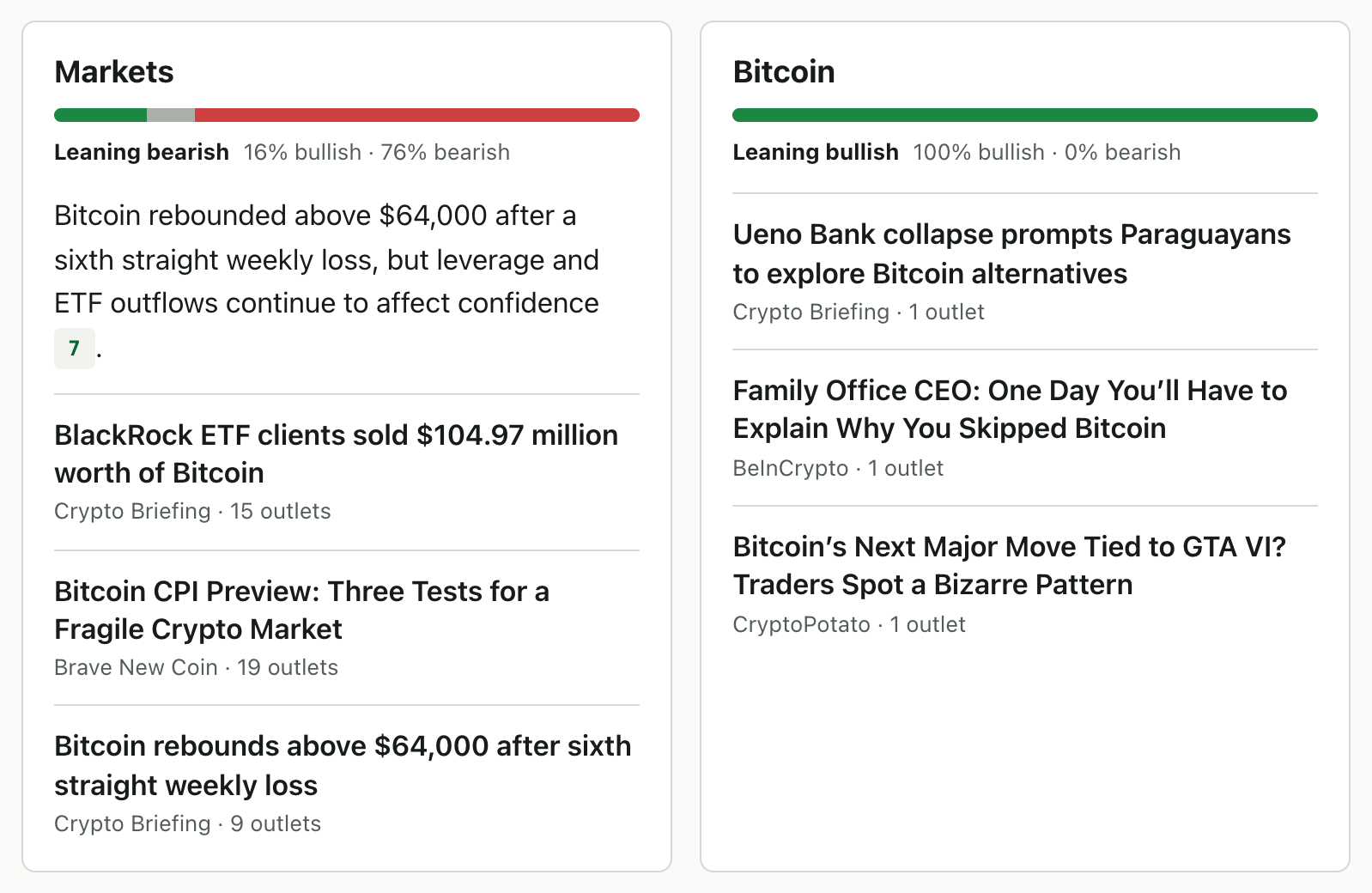
Cryptoheadlines.com gives readers more. They get the day’s crypto news on one page, sorted by topic, with every article credited to the outlet that wrote it. On 17 November 2026, one story there held 104 articles from 23 outlets.
News sorted by topic on the cryptoheadlines.com homepage, 19 November 2026. Aggregator Pro brings in the articles; the site’s own code adds the mood bars, summaries and outlet counts.
The short version
Add the outlets you follow as sources.
Import posts that credit and link to the original.
Use keywords to keep imports on-topic.
Add AI summaries within your credit budget.
Put topic displays together on one page.
What’s Aggregator Pro, and what’s custom
Aggregator Pro brings in the articles from every outlet. The site’s own code then groups articles about the same event and ranks the stories. It also adds the mood bars, price displays and hourly roundup.
The five moves below cover the Aggregator Pro part, with no code. Developers can follow the build guide or the site’s how it’s built page for the rest.
Move 1: Collect your sources in WordPress
Cryptoheadlines.com collects feeds from outlets such as CoinDesk, The Block, Decrypt and Cointelegraph. When we looked on 17 November 2026, 47 of its top 60 stories had coverage from several outlets.
A story card on 19 November 2026 shows coverage from 26 outlets. Aggregator Pro imported the articles behind it.
Aggregator Pro checks the feeds on a schedule and skips items it has already stored. Each item keeps its headline, excerpt, publish time, image, source name and original link.
It also handles messy feeds. You can add, pause or replace sources from the WordPress dashboard.
The site’s owner, Jean Galea, chose WordPress for this import layer. As he put it in his build guide: “WordPress still does the hardest, most boring part of a news site better than anything I’d write from scratch.”
Add the outlets you follow as sources. These crypto feeds are set up on our test site.
Set it up on your site
Enter an outlet’s homepage URL in Feed Finder and copy its feed address.
In the WordPress dashboard, open Aggregator, then Sources. Click Add a new source and add the feed. Our guide to adding a source covers each field.
Under Update strategy, choose how often to check it. Repeat for your other sources.
Move 2: Import posts that credit the source
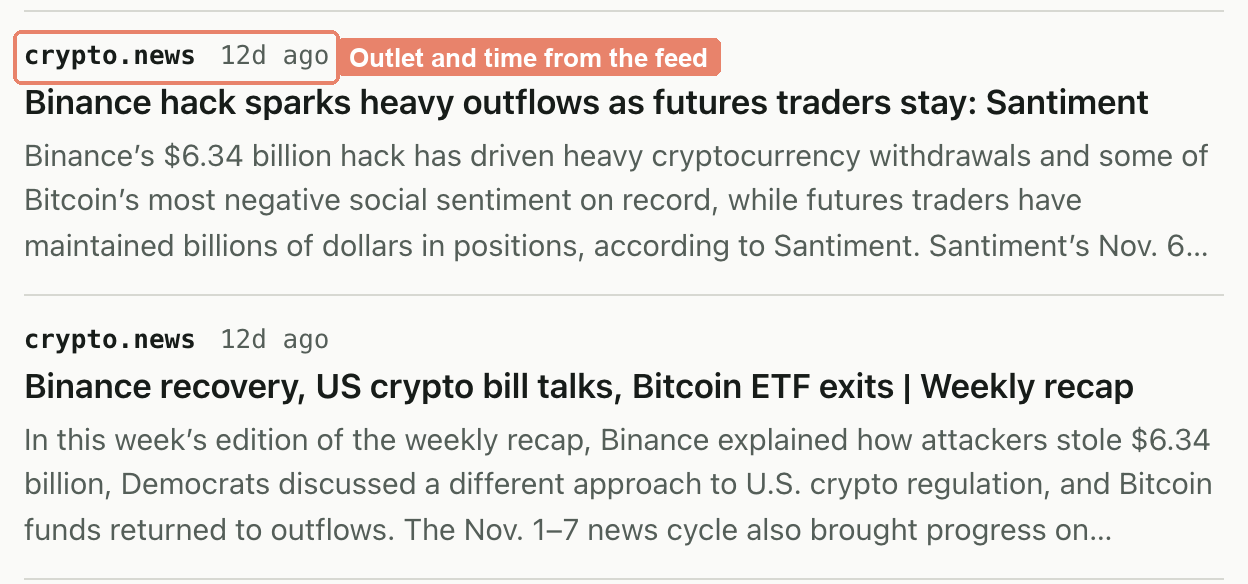
Cryptoheadlines.com stores the articles as feed items. Each one keeps the outlet name and a link to the original.
Articles on the Binance story page, captured on 19 November 2026. Each shows its outlet and publish time.
For your site, Feed to Post can turn imported articles into WordPress posts. They appear in your theme and site search, and Pro can add a credit line linking to the original.
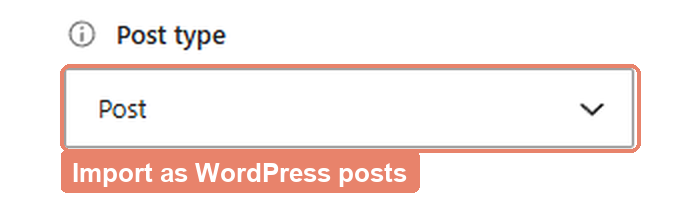
Example attribution setting, shown as a mock-up: the credit line added to each post from this source.Choose Post to import articles as WordPress posts.
Turn on Set canonical link to identify the original article as the primary version for search engines. These imported posts give readers a way to browse news on your site.
If you import full articles, check each outlet’s terms first. Republishing a whole story can need the publisher’s permission. Our guide to posting RSS feeds to WordPress covers attribution and full-text import.
Set it up on your site
Open a source and set Post type to Post.
Choose Post status. Use Draft to check imports before they go live, or Published to publish them as they arrive.
Turn on Set canonical link. See canonical links for what it changes.
Go to Advanced, then Attribution. Turn on Show Attribution and edit the Attribution Text to name the outlet and link to the original. Save and fetch the source. The attribution guide lists the text options.
A source may cover more than your readers need. On 17 November 2026, a story about Anthropic’s business led the cryptoheadlines.com data feed, with coverage from 17 outlets.
The site files stories by topic. Its Regulation page shows how a topic gives readers a smaller set of stories to browse.
Stories on the cryptoheadlines.com Regulation page on 19 November 2026, each tagged with its topics.
For your imports, Aggregator Pro can check titles for keywords before saving an article. Choose the words that fit your subject in the source’s Automations tab.
Example rule, shown as a mock-up: import only titles containing one of these crypto keywords.
Set it up on your site
Open the source’s Automations tab.
Choose Title, then Contains any. Enter your keywords.
Set Then to Import item and save. Articles without a matching word stay out.
The cryptoheadlines.com homepage opens with a roundup, written by the site’s own code. Each sentence links to the article behind it, so readers can check the source.
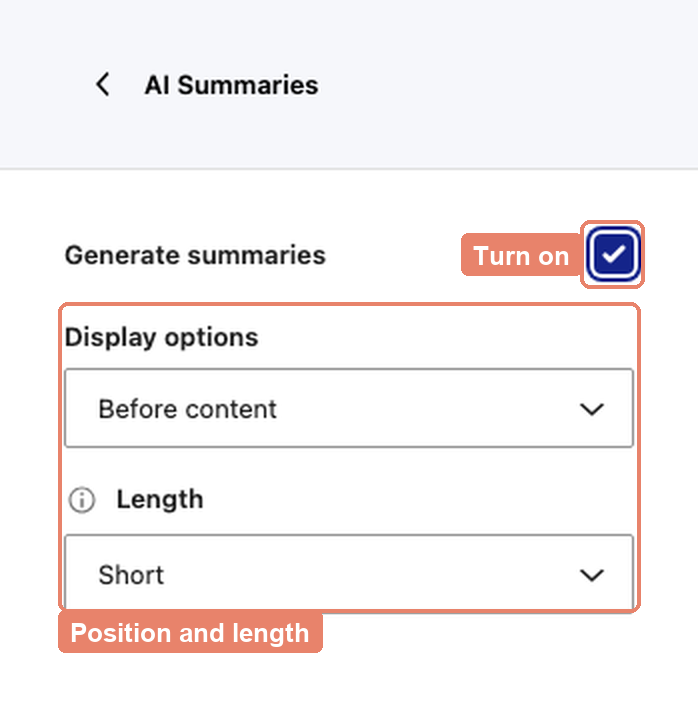
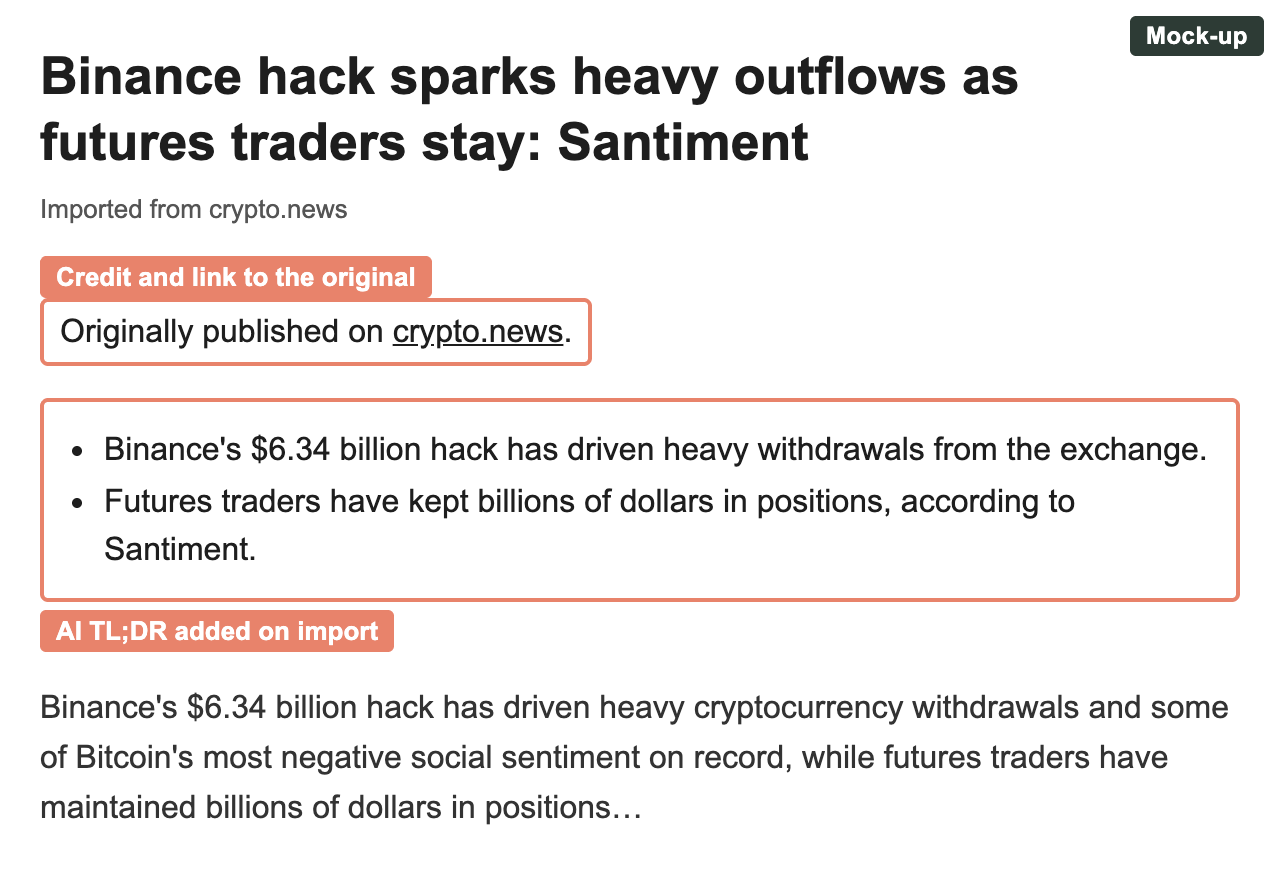
On your imported posts, Aggregator Pro offers AI Summaries and AI TL;DRs. AI Summaries adds a short paragraph. AI TL;DRs adds bullet points so readers can scan the main points.
The one-site Pro plan includes 500 AI credits a year, or about 40 a month. Each summary or TL;DR uses one credit. Our page on AI credit usage explains what else counts.
Turn on AI Summaries, then choose its position and length.Example post, shown as a mock-up: a source credit and an AI TL;DR above the imported text.
Refreshes use credits too. This includes clicking Fetch or Update when a source is set to keep items up to date.
On our test site, one CoinDesk fetch brought in 25 articles. Start with one source and filter its imports before turning on summaries. Extra credit packs are available if you need more.
Set it up on your site
Open your filtered source. Go to Advanced, then AI, then AI Summaries.
For a short paragraph, tick Generate summaries. Choose where they appear and how long they are.
For bullet points like the example above, use AI TL;DRs on the same source instead.
Under Credit Strategy, choose Import items without AI summaries. New articles can then keep arriving when credits run out.
Move 5: Put news topics on one page
Cryptoheadlines.com breaks the news into sections, as in the screenshot at the top. Readers can browse markets, Bitcoin, regulation, DeFi and security.
In WordPress, you can make one Aggregator display for each topic. Stack the displays under headings on a single page so readers can find the news they came for.
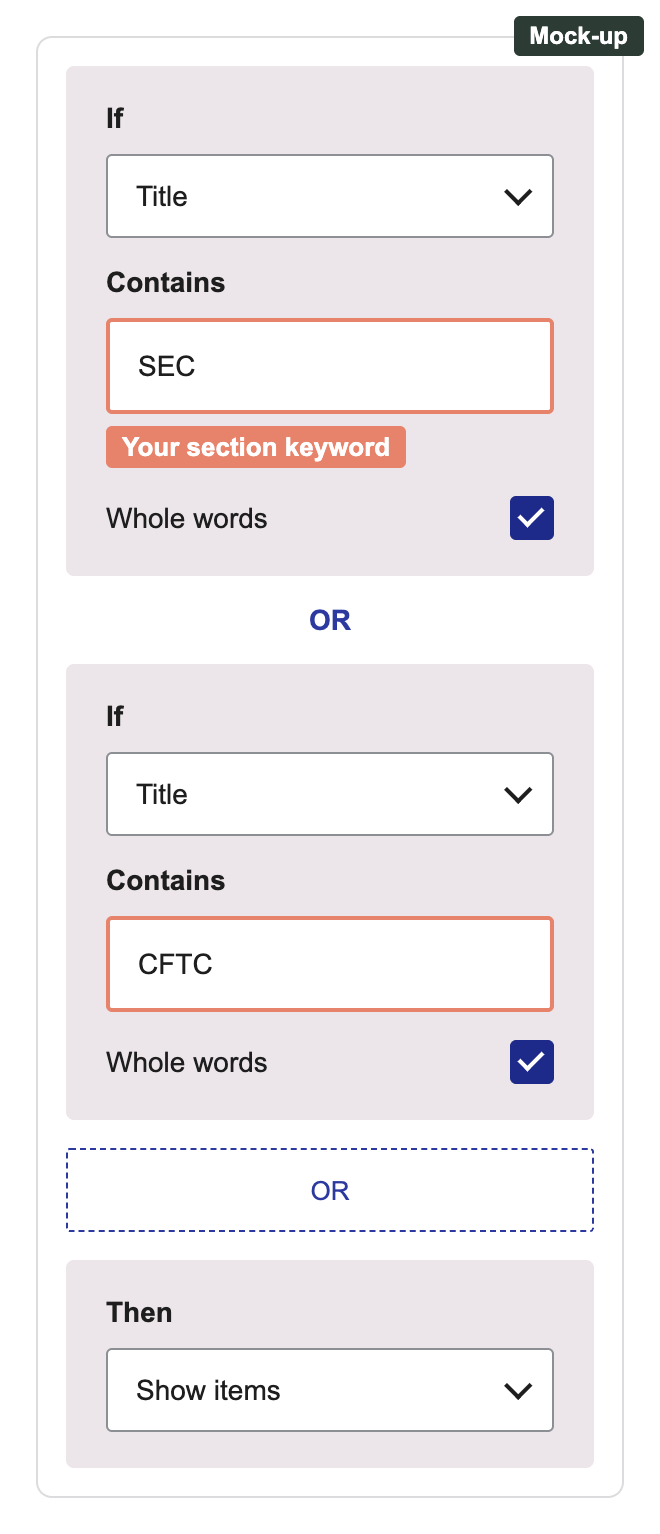
Example display filter, shown as a mock-up: show titles containing SEC or CFTC.Example page, shown as a mock-up: two filtered displays stacked under topic headings.
Set it up on your site
Open Aggregator, then Displays. Click Create a new display and choose your sources.
Open Filtering. Choose Title and enter a topic keyword under Contains, such as SEC.
Tick Whole words. This keeps a word such as SEC from matching security.
Set Then to Show items. Add other keywords with OR, then save. The filter matches your words, not related terms. See display filters for more rules.
Make a display for each topic. Add them to one page with the Aggregator block, each under its own heading.
Start with one feed
Add one outlet as a source today and import a day of posts as drafts. Check what comes in, then add your keywords, summaries and topic pages.
Add a few more outlets, and you have a news page readers can check every morning.
Aggregator Pro for WordPress
Turn your feeds into a news page
Pick the outlets you trust. Aggregator Pro brings in their newest stories, keeps them on-topic and adds summaries, each one credited and linked to the publisher.
RSS and Atom are two XML formats for the same job: a file that lists a site’s newest posts so apps can pick them up. The real difference is the rules: Atom requires an ID, a title and an update time on every post, while RSS is older and looser. It only matters for podcasts, which need RSS; for reading feeds or importing them into a website, either format works.
We make Aggregator, a WordPress plugin that imports both formats, so we ran the same feeds through it to see what actually changes. Here’s what we found:
The same WordPress.org News post came out identical from RSS and Atom, except that only Atom added the time the post was last edited.
Atom requires a permanent ID on every post, which is what an importer uses to skip posts it already has. In RSS the ID is optional, so when it’s missing, Aggregator uses the post’s link instead.
YouTube’s Atom feed keeps each video’s description in a separate media element, so a basic importer gets only the title.
Both formats are written in XML: plain text where each piece sits between labels, like <title> and </title>. RSS and Atom often name the same piece differently, so a post’s date is pubDate in RSS and published in Atom.
Compared
RSS
Atom
Looked after by
The RSS Advisory Board
The IETF, which sets internet standards. The rules are in a document called RFC 4287
Current version
RSS 2.0.11, from March 30, 2009
Atom 1.0, from December 2005
The file starts with
<rss>
<feed>
One post is called
an item
an entry
Every post must have
a title or a description
an ID, a title and an “updated” time
Dates look like
Tue, 03 Nov 2026 15:45:29 +0000
2026-11-03T15:45:29Z
Says whether text contains HTML
No
Yes
Summary and full post
One description element; the full post needs an add-on element
Separate summary and content elements
Records when a post was last edited
No
Yes
Accepted by Apple Podcasts
Yes
No
Atom came from people who found RSS too vague. RSS never says whether a post’s description is plain text or HTML (the code that formats web pages), and it lets a post go without an ID. Atom spells out both.
What is an Atom feed?
An Atom feed is a feed written in the Atom Syndication Format, which the IETF published in December 2005. You follow one the same way as an RSS feed, by pasting its address into a feed reader or a plugin. YouTube channels, GitHub releases, Blogger blogs and Google Alerts all send Atom.
RSS vs Atom: the same post in both formats
WordPress makes both formats for every site, so it’s a fair comparison. Here’s the same WordPress.org News post as RSS and as Atom. Tap a line on either side to see its partner.
wordpress.org/news/feed/
Atom wordpress.org/news/feed/atom/
guid in RSS, id in Atom
A permanent ID. Apps use it to recognize a post they’ve already shown you. It’s optional in RSS and required in Atom. WordPress puts the same ID in both.
All ten pairs explained
item in RSS, entry in Atom
One post. RSS calls it an item, Atom calls it an entry.
title in RSS, title in Atom
The headline. Atom adds type=”html” so apps know how to display it.
link in RSS, link rel="alternate" in Atom
The address of the post on the website.
dc:creator in RSS, author in Atom
Who wrote it. RSS borrows this element from an add-on called Dublin Core. Atom has its own, with a name and a profile link.
pubDate in RSS, published in Atom
When the post went live. Same moment, two date styles.
Nothing in RSS, updated in Atom
When the post was last changed, five minutes after publishing here. RSS has no element for this. Atom requires it.
guid in RSS, id in Atom
A permanent ID. Apps use it to recognize a post they’ve already shown you. It’s optional in RSS and required in Atom. WordPress puts the same ID in both.
category in RSS, category term in Atom
The post’s categories and tags.
description in RSS, summary in Atom
A short summary of the post.
content:encoded in RSS, content in Atom
The full post. RSS needs an add-on element for it. Atom has one built in.
Shortened and simplified for space. The real entries list five categories and the whole post.
Most of it matches: the whole post, the same ID and the same publish time. That’s because WordPress.org chose to send everything in both formats. Our own blog sends only summaries, in RSS and Atom alike.
Which sites use RSS and which use Atom
Most feeds you’ll meet are RSS. Atom shows up on Google’s YouTube, Blogger and Google Alerts, and on GitHub. We opened every feed below and loaded each one into Aggregator on a test site. All of them worked except Reddit’s, which blocked our test server, and GitHub’s RSS address, which doesn’t exist.
Feed
Address
Format
The Verge
https://www.theverge.com/rss/index.xml
AtomAddress says RSS
Reddit (r/WordPress)
https://www.reddit.com/r/WordPress/.rssUntil November 13.
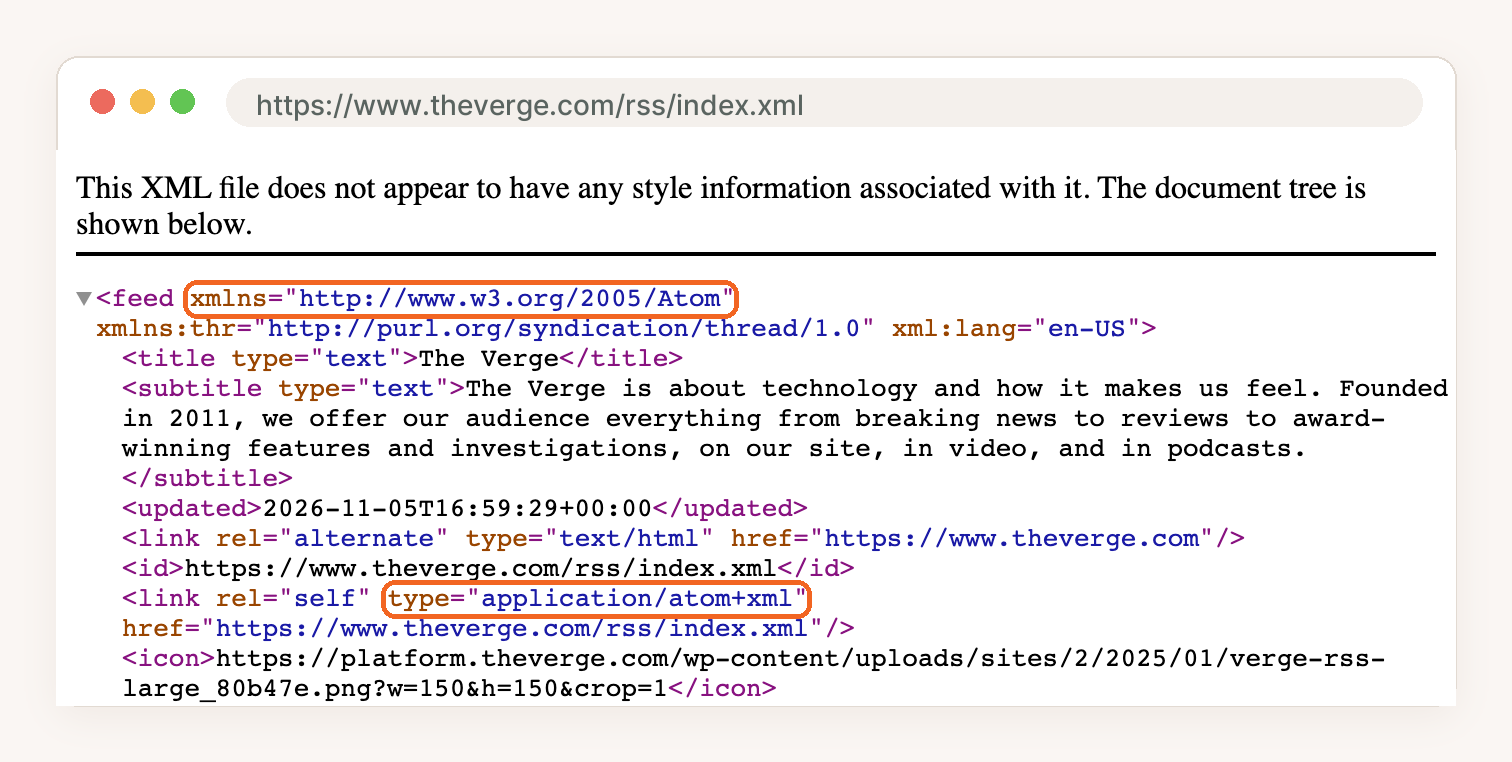
You can’t judge a feed by its address. The Verge’s feed lives at theverge.com/rss/index.xml, but the file is Atom. Reddit’s .rss feeds are Atom too, until Reddit turns them off on November 13. Here’s The Verge’s feed opened in Chrome:
The address says rss, but the first element is <feed> in the Atom namespace.
Open the feed in your browser: an RSS file starts with <rss> (with <channel> inside it, not on top), and an Atom file starts with <feed xmlns="http://www.w3.org/2005/Atom">. Don’t trust the web address or the file type the server sends: six of the 14 working feeds we tested called themselves plain XML. Or paste the first few lines into the checker below, which runs in your browser and fetches nothing.
Is this feed RSS or Atom?
Try a sample:
If a feed won’t load at all, a feed validator will show what’s broken.
On paper, yes. Atom is stricter and leaves less for apps to guess. In practice RSS is far more common.
In a May 2023 sample of home pages by the HTTP Archive, half pointed to an RSS feed and only 8% to an Atom feed. The real Atom share is a little higher, because WordPress makes an Atom feed for every site but only links the RSS one in its page code.
What it means for you depends on what you’re doing:
If you read feeds in an app, the format doesn’t matter. Use whichever address you have.
If you show other sites’ posts on your WordPress site, it doesn’t matter either, as long as your plugin reads both.
If you publish a blog, keep the format your platform makes. Both work everywhere.
If you publish a podcast, use RSS. Apple Podcasts requires RSS 2.0.
Aggregator reads feeds with SimplePie, the feed-reading code that comes with WordPress, and that’s how we ran the test above. It also reads each YouTube video’s description from that media element, so imported videos keep it.
One thing no format fixes: if a site’s feed carries only a summary, that’s all you get, in RSS or Atom. Aggregator Pro’s full text import fetches the rest of each article from the site.
Keep what your platform makes. WordPress already serves RSS 2.0 at yoursite.com/feed/ and Atom at yoursite.com/feed/atom/, plus two older formats. If you move your main feed to a new address, anyone who subscribed to the old one stops getting your posts, unless the old address redirects to the new one.
To put other sites’ posts on your own site, start with the feed’s address. Here’s how to find any website’s RSS feed. Then add it to Aggregator as a source and show it on a page with the Aggregator block or shortcode. To publish the items as WordPress posts instead, follow our guide to importing RSS feeds into WordPress posts.
Turn these feeds into a page that updates itself
Pick any feed from this article, RSS or Atom, and add it to Aggregator. The free plugin checks it on a schedule, hourly unless you change it, and adds each new post to your WordPress page.
yoursite.com/news/
Today’s reading
Interest rates hiked to 4% in first increase in over three years BBC News · Nov 5, 2026
The FAA is finally ditching floppy disksAtom The Verge · Nov 5, 2026
WordPress 7.2 Beta 4Atom WordPress.org News · Nov 3, 2026
FAQ
Can an RSS reader read Atom feeds?
Yes. “RSS reader” is just the common name for any feed reader, and they’re made to read both. NetNewsWire’s help page, for example, says it handles RSS, Atom and JSON Feed.
Can I convert an Atom feed to RSS?
You can, with an online converter, but there’s rarely a reason to: anything that reads feeds takes Atom as it is. A converter also adds a second address that stops updating if the service shuts down.
Is an RSS feed an XML file?
Yes. RSS and Atom feeds are both XML files, which is why your browser shows a page of tags when you open one.
Is RSS still used in 2026?
Yes. Podcasts run on RSS, and plenty of news sites and blogs still publish feeds. Our guide to what an RSS feed is shows real ones you can open.
What about JSON Feed?
JSON Feed is a third format that does the same job in JSON instead of XML. Fewer apps read it than RSS or Atom, and Aggregator doesn’t.
Why does my WordPress site have an Atom feed I never set up?
WordPress makes one for every site, next to the RSS feed. Add /feed/atom/ to your site address to see it. You don’t have to do anything with it.
Most big news sites still publish RSS feeds that work. The BBC, NPR, The New York Times, Bloomberg and The Guardian all had fresh stories in theirs when we checked in October 2026, and the tables below have their addresses plus dozens more.
A few famous feeds are a different story. CNN’s still loads, but the newest item in it is from May 2023. Reuters shut its feeds down in 2020, and AP’s own feed now blocks readers.
Those dead addresses still get passed around, so we’ve listed them too, along with what to use instead.
You’ll also find what each publisher allows if you want their headlines on your own site, and how to set that up in WordPress.
For general news, start with these five. They post all day and come with images.
NPR and The Guardian are free to read. The New York Times feed is free as well, though most of the stories it links to are for subscribers.
Best RSS feeds for breaking news
Pick a busy feed. The Independent’s news feed posted more often than any other we checked, with a new story every few minutes. Fox News and Al Jazeera weren’t far behind.
Fox News and Axios send the whole article. Nice for reading. On your own site, you’d still show an excerpt and link back.
Everyone else on this list keeps it to a headline and a sentence or two.
Politico splits its news into topic feeds, and some of them barely move. Its economy feed had three stories in it when we looked. Stick to politics and congress.
Headlines about that ticker (swap AAPL for any symbol)
Wall Street Journal readers should check their feed address. The current feeds live on feeds.content.dowjones.io. The old feeds.a.dj.com addresses still load, but nothing new has landed in them since January 2025.
That catches a lot of people, because some popular feed lists (and even Google’s AI answers) still hand out the old ones. MarketWatch moved to the same Dow Jones address.
Yahoo Finance dropped its general news feeds. You can still follow the headlines for one stock at a time, like Apple in the table above.
rss.feedsportal.com/… (still linked from its own RSS page)
Gone.
https://www.independent.co.uk/news/rss
To check a feed yourself, open its address in your browser and look at the date on the top story. Some browsers show raw code instead of a tidy page. Search that for pubDate, and the first one you hit is the newest story.
On a news site, anything weeks old means the feed is dead, even though it loads.
Reddit’s feeds are next. Reddit ends RSS support on November 13, so if you follow news through subreddits, those feeds will stop updating. Our Reddit RSS guide covers what changes and what to use instead.
Google News can build a feed for a site that no longer has one. This address returns the latest Reuters stories:
Swap reuters.com for any other site. Keep when:24h, or the feed fills up with old stories. When we left it out for USA Today, one result was from 2006.
To get a single section, add it to the address, as in site:reuters.com/world. That only works when a site puts its sections in its web addresses. AP doesn’t, so add a keyword instead: site:apnews.com politics.
These are fine for reading. Put them on a site and you’ll notice a few quirks:
Stories arrive without images, just a headline and a line of text.
Every link opens news.google.com first, then redirects to the article.
The publisher’s name is stuck on the end of each headline, as in “Nvidia wins fast-growing AI startup Modal for new central processors – Reuters”.
“We encourage the use of BBC News feeds as part of a website, however, we do require that the proper format and attribution is used when BBC News content appears.”
Its RSS content is available “for personal use (e.g., in a news reader), for many commercial purposes, or for any other form of distribution to a third party.”
“you are only permitted to display the content that is provided in the feed, with attribution to TechCrunch, and you must link to the full article on TechCrunch. You may not incorporate advertising into any TechCrunch RSS feed.”
“We allow the use of NYTimes.com RSS feeds for personal use in a news reader or as part of a non-commercial blog. We require proper format and attribution whenever New York Times content is posted on your website.”
“for your personal, non-commercial use only and any republication or other use of our content will require a licence.”
The safe way to show any of these on a site is the headline, a short excerpt and a link back, with the publisher’s name kept on it. Running ads against someone else’s feed is off limits under several of these terms, CNN’s and TechCrunch’s included.
A site that earns money needs a closer read of each publisher’s terms, and an email to the publisher is the quickest way to a clear answer. (This isn’t legal advice.) Our guide to posting news articles on your website goes into more detail.
Which news feeds look best on a website
In a reader app, one feed looks much like another. On a web page, the gap is obvious. Some feeds bring a photo and a couple of lines with every story. Others bring a bare headline.
BBC News feed
Photo included
Watch: Are the French riots a warning of an intense election to come?
Rioting, looting and vandalism has gripped France over the weekend after protests spiralled out of control across the country.
Summary: one lineLink goes to: bbc.co.uk
Reuters via Google News feed
No image
Kenyan starvation cult leader convicted in deaths of nearly 200 children – Reuters
Kenyan starvation cult leader convicted in deaths of nearly 200 children Reuters
Summary: none beyond the titleLink goes to: news.google.com, then redirects
One real story from each feed, side by side.
Pictures are the norm. Bloomberg, CNBC, ESPN, TechCrunch, Al Jazeera and Deutsche Welle don’t, and neither does any Google News feed.
Text varies more. A sentence or two is typical. The Guardian often sends a full paragraph, and Fox News, Axios and Business Insider send the whole article.
For a page that looks like a real news site, lean on the feeds with pictures. Put the rest in a plain headline list or a sidebar.
Aggregator, our WordPress plugin, turns any of these feeds into a news page that keeps itself up to date. The free version is all you need to get started.
1. Add a feed as a source
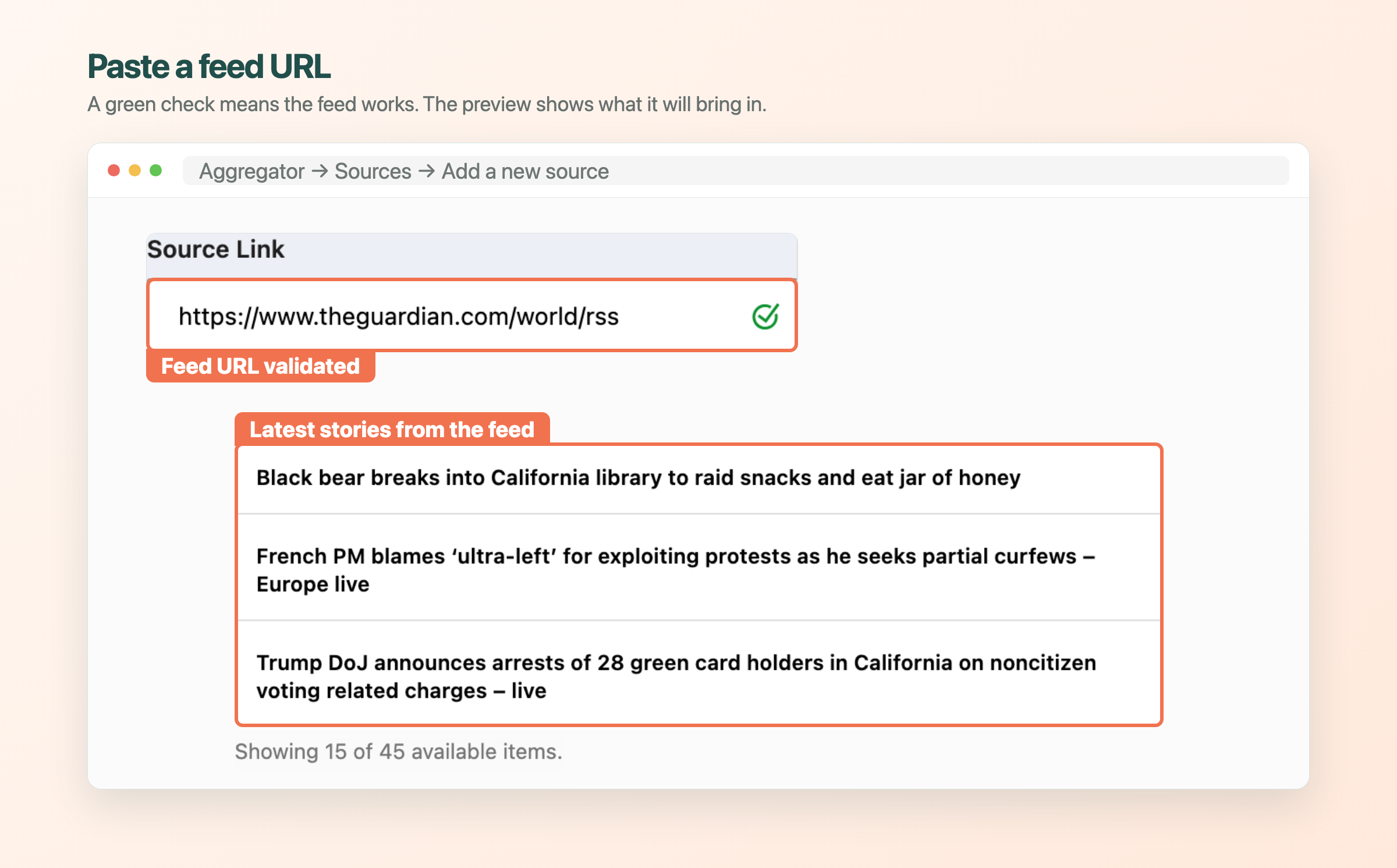
Install the free Aggregator plugin. In your WordPress dashboard, go to Aggregator > Sources, click Add a new source and paste in a feed address from this page.
A green check means the feed works. The preview next to it shows the latest stories.
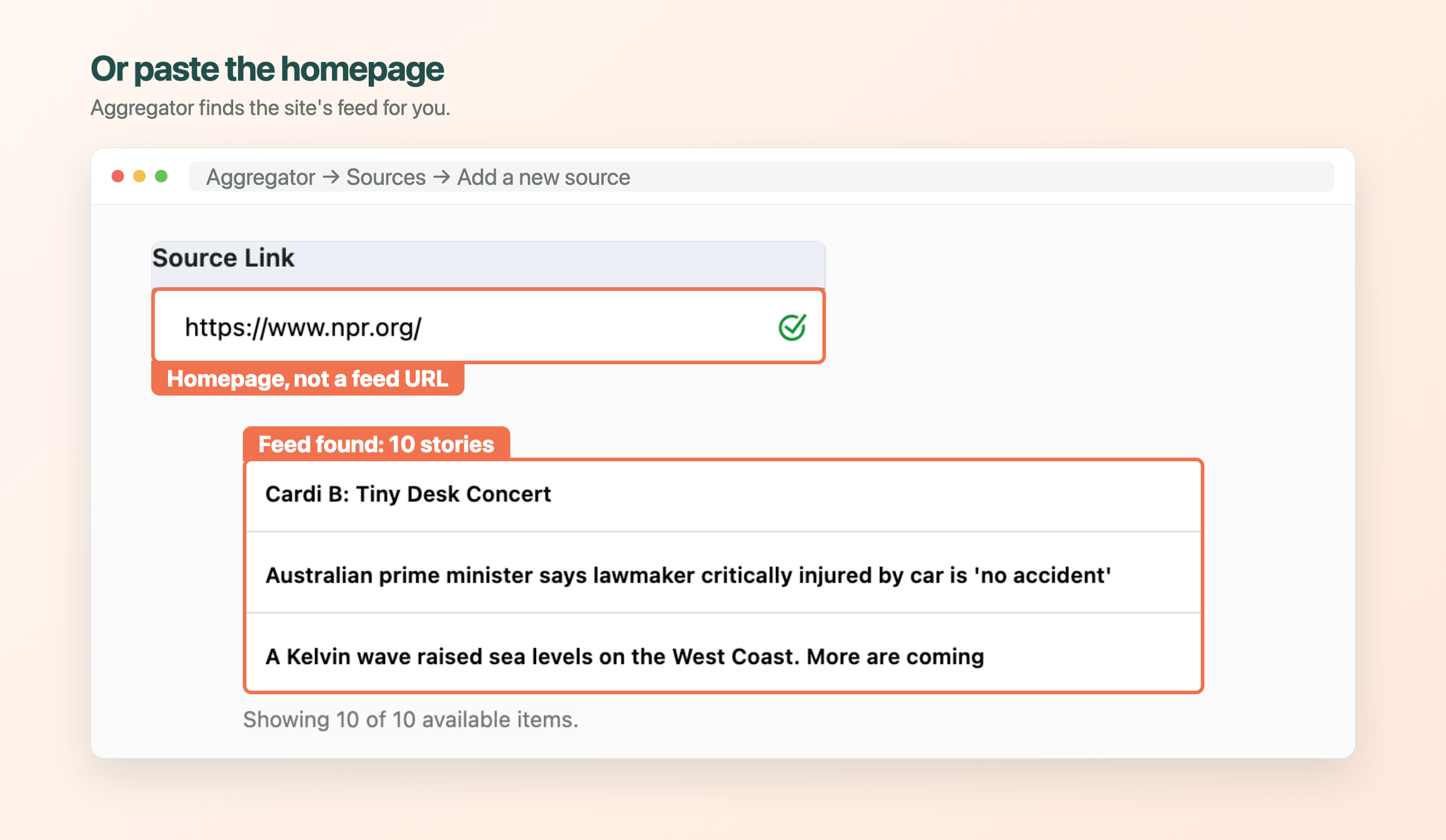
For many sites you don’t even need the feed address. Paste the homepage and Aggregator finds the feed for you. That’s how we added NPR. We pasted npr.org, and it picked up the feed on its own.
Click Save, then Import, and repeat for each outlet.
2. Show the stories on a page
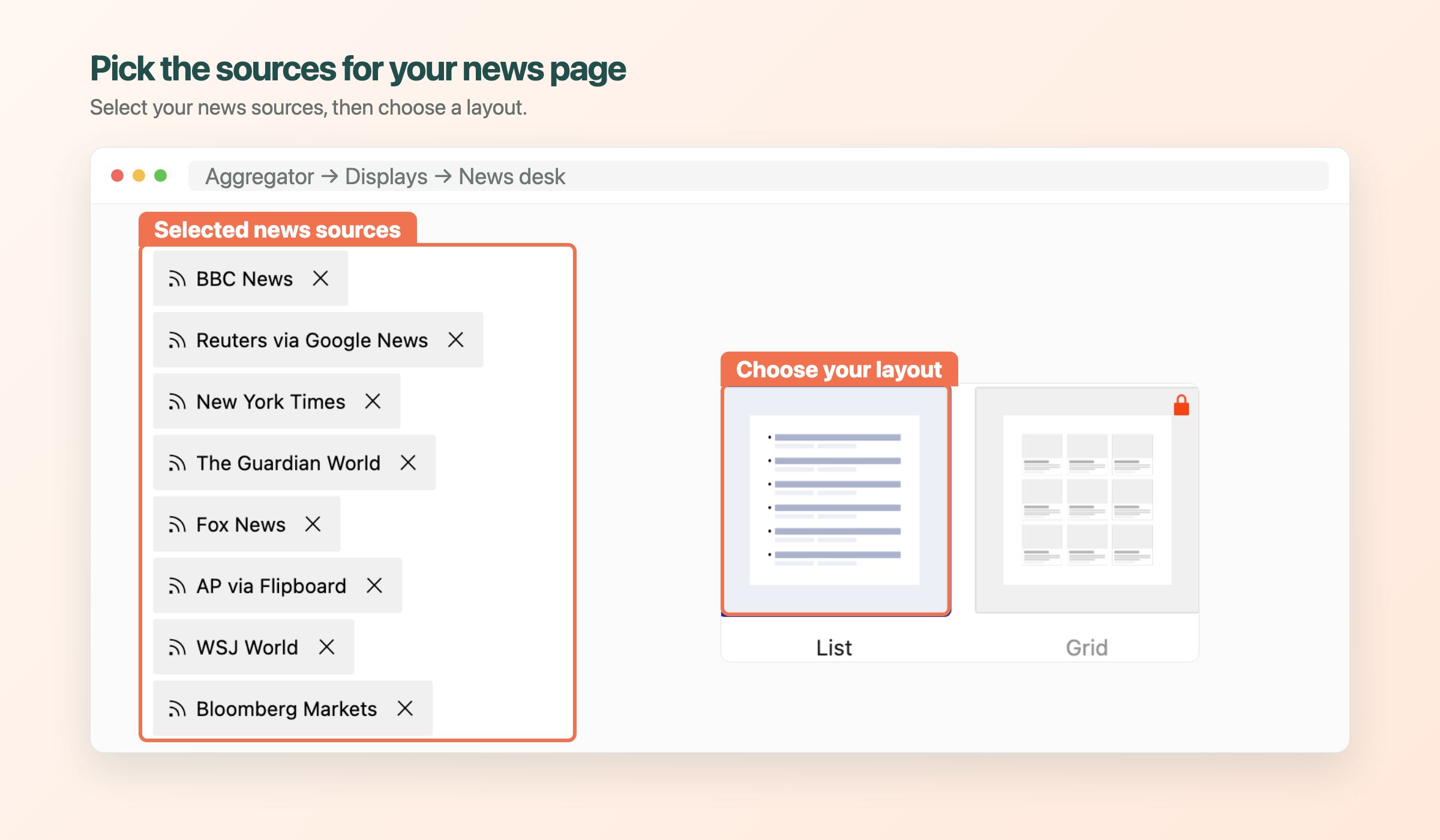
Go to Aggregator > Displays and click Create a new display. Choose your sources and how many stories to show, then add the display to a page with the Aggregator block or the [wp-rss-aggregator] shortcode.
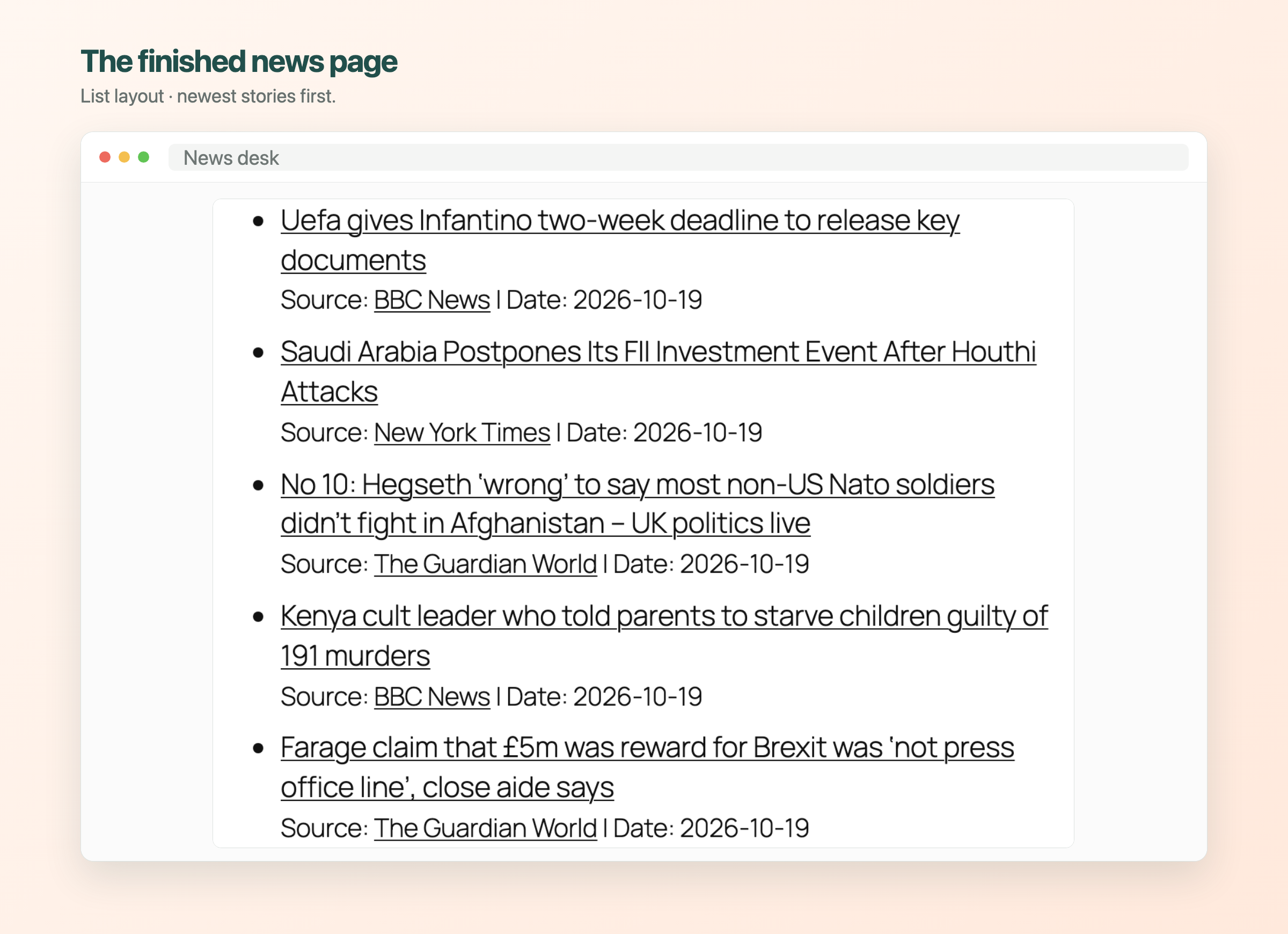
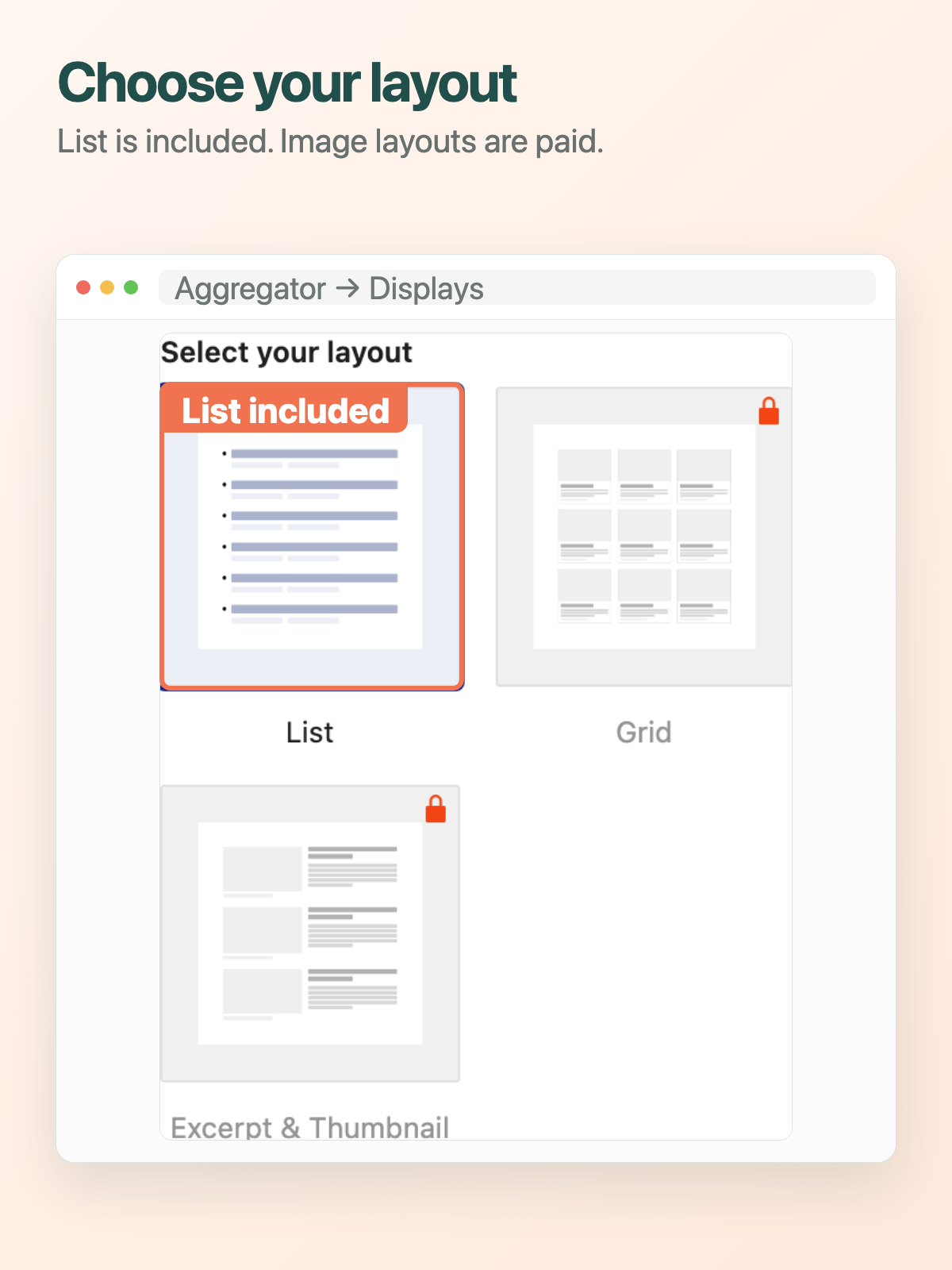
The free plan uses the List layout, which shows each headline with its source and date underneath.
New stories appear on the page as the feeds update, newest first.
3. Add images, folders and filters when you need them
A headline list works well in a sidebar or a “latest news” box. When you’re ready for a full news page, the paid plans add:
Grid and Excerpt & Thumbnail layouts show a picture and summary for each story. That’s where feeds with images, like the BBC, NPR and The Guardian, look their best. (Basic plan)
Folders group your sources, so one display can show world news and another business. (Basic plan)
Keyword filters keep only the stories that match. Point one at a Google News feed for reuters.com, filter for “markets”, and you have a Reuters markets feed. (Basic plan)
Import as posts turns each story into a regular WordPress post with its featured image, so it fits your theme’s layouts and site search. (Pro plan)
Paid plans start at $99 a year. You can compare them on the plans and pricing page.
Download every working feed in one file
All 111 working feeds we found are in one file, sorted by topic. That’s more than the tables show.
It’s an OPML file, a standard list of feeds that Feedly, Inoreader and NetNewsWire can import in one go.
The full list is below too, if you’d rather copy feeds one at a time.
Yes, lots of people. Feedly, Inoreader and NetNewsWire are all built on RSS, and 35 of the 38 big news sites we checked still publish a working feed.
What does RSS mean in news?
RSS stands for Really Simple Syndication. For a news site, the RSS feed is a list of its latest stories that updates as new ones go up, usually with a headline, a short summary and a link. Reader apps and plugins like Aggregator check that list and pull in anything new.
What is replacing RSS feeds?
For news sites that dropped RSS, it’s mostly their own apps and email newsletters. Search for Reuters’ RSS feed, and Reuters’ own result is a page asking you to get the Reuters News app. Inside a feed reader, the practical replacement is a Google News feed for that site, or a Flipboard feed where the outlet has one, as AP does.
Which news sites have RSS feeds?
Most of the big ones, including the BBC, The New York Times, NPR, The Guardian, Fox News, NBC News, CBS News, Bloomberg, The Wall Street Journal and The Verge. CNN, Reuters and USA Today no longer have working feeds.
What is the best RSS feed for news?
BBC News, NPR and The Guardian are the safest picks for general news. All three post all day and include images, and NPR and The Guardian don’t charge to read.
Does Google News have an RSS feed?
It does, through search. Put any search after https://news.google.com/rss/search?q= and you get a feed of the results. It’s also the easiest way to follow a site with no feed of its own.
Does CNN still have an RSS feed?
Not one that still updates. CNN’s RSS page is online, but its feeds stopped getting new stories in 2023 and 2024. A Google News feed for cnn.com is the workaround.
Does Reuters have an RSS feed?
No. Reuters ended its public feeds in June 2020. A Google News feed for reuters.com does the same job today.
Does the Associated Press (AP News) have an RSS feed?
AP’s own feed address blocks readers now. Its official Flipboard account has a working feed at https://flipboard.com/@AssociatedPress.rss, and each story links straight to apnews.com.
Does the Wall Street Journal have an RSS feed?
It does, on a new address. The world news feed, for example, is https://feeds.content.dowjones.io/public/rss/RSSWorldNews. The old feeds.a.dj.com addresses stopped updating in January 2025.
Does the New York Times have an RSS feed?
Dozens of them. The home page feed is https://rss.nytimes.com/services/xml/rss/nyt/HomePage.xml, with separate feeds for world news, business, technology and other sections.
Are news RSS feeds free?
Following a feed costs nothing. Reading the full story is another matter at the NYT, WSJ, Bloomberg and the FT, where most articles need a subscription. Their feeds still give you the headlines and summaries.
Aggregator for WordPress
Turn these feeds into a news page
Pick the outlets you trust, and Aggregator fills your page with their newest stories as the feeds update, each one credited and linked to the publisher.
Reddit is turning off RSS on November 13, 2026. After that date, Reddit’s own RSS feeds stop updating in Feedly, Inoreader and every other reader, and in any WordPress display that imports them. Posts you’ve already collected stay where they are.
Reddit isn’t giving readers a replacement feed, so you’ll need to decide what to do with each Reddit feed you follow. The examples below use one ordinary setup: r/homelab, r/programming and r/spacex in a feed reader, plus a “Latest from r/photography” sidebar on a WordPress photo blog.
RSS support endsNovember 13, 2026Reddit feeds stop updating in readers and WordPress imports.
What happens to your Reddit feeds?
Nothing is scheduled to change before the cutoff. On November 13, the three subscriptions stop getting new posts. They stay in your reader, so it can look as if the subreddits just went quiet. The sidebar on the photo blog stops updating at the same time.
Subreddit, user and search feeds all stop, because Reddit hasn’t exempted any of them. Switching readers won’t help either, since the feeds are being withdrawn at the source. Inoreader has already told its users it can’t fetch Reddit posts once Reddit stops serving them.
After the RSS cutoff13 NOV 2026
New Reddit posts
Reddit stops serving its feeds, so readers and importers receive nothing new.
×
Content already saved
Stays in your reader or on your site, under that app’s own storage rules.
The cutoff stops new posts from arriving. It doesn’t touch what’s already in your reader or your WordPress database.
Posts you already have aren’t touched. Your reader keeps them under its normal storage rules, and the r/photography posts Aggregator imported stay in your WordPress database.
Check one setting on that source, though. An age limit deletes each imported post a set number of days after import, and it keeps running after the feed stops. With a 30-day limit, the sidebar empties itself about a month after the last import.
A limit on the number of stored items doesn’t do this, because it only removes old posts when new ones arrive.
With no age limit, the sidebar freezes instead. In January it still shows November’s photos, which makes the site look unattended. If r/photography shares a display with other sources sorted newest first, its posts sink out of view.
Why is Reddit ending RSS support?
Reddit says scrapers were using RSS to copy its posts in bulk, along with other automated abuse, and it’s closing the feeds to stop them. It announced the change on September 30.
Feed readers are cut off as a side effect. The announcement says anyone using RSS outside a community they moderate gets no replacement, even as it thanks RSS users and calls RSS “a beloved part of the open web.” Don’t plan around a reversal or a readers-only version.
Moderators are the exception. Some mod teams run their alerts on RSS, so Reddit points them to Discord Relay, which sends those alerts to the team’s Discord or Slack. Relay doesn’t produce a feed, so it won’t help a reader or the photo blog.
What to use instead of Reddit RSS
Start with why you followed each subreddit. Another feed can cover links and news. It can’t cover a community, because the conversation stays on Reddit.
In the example setup, r/homelab is a community: people there answer questions about your hardware. r/programming is a link filter. r/spacex is mostly news, with discussion on top.
Options after the Reddit RSS shutdown
What you need
Option to consider
What it can replace
A specific subreddit’s posts and discussions
Reddit’s own site or app
The same community, read on Reddit instead of in your reader. Reddit offers no subscriber feed after the cutoff.
Technology links ranked by other readers
Hacker News feeds
Voted stories with comment threads, picked by a different community with its own interests.
News about a company, product, or place
Google News search feeds or publisher RSS
Reporting on the same subject. The subreddit’s own posts and discussion don’t come with it.
Alerts for a community you moderate
Discord Relay on Reddit’s Developer Platform
New posts, comments, and moderation events sent to Discord or Slack. It doesn’t create a feed for readers or WordPress.
For a community you care about
Follow it on Reddit. Join r/homelab with your Reddit account and its posts appear in your home feed. You lose having it in your reader, but you keep the conversation.
For technology links
Use Hacker News in place of r/programming. It works in a similar way: people submit links, vote on them and discuss them. The crowd leans toward software and startups.
Subscribe to https://hnrss.org/newest?points=100 to get only stories with at least 100 points. The feed comes from hnrss, a community-run service. Expect some overlap with r/programming, not the same list. For a hobby or local subreddit, Hacker News isn’t a substitute.
For news about a subject
If you mostly read r/spacex for launch news, use a Google News search feed. A search feed for “SpaceX” collects coverage from many publishers without anyone having to post the links.
You won’t get the comment threads, where people go through landing footage frame by frame. If those were why you subscribed, keep r/spacex on your Reddit list instead.
If a subreddit mostly shared links from the same few sites, subscribe to those sites’ feeds directly. For news sites, our list of news RSS feeds that still work has the current addresses.
For mod alerts
If your mod team gets alerts through RSS, set up Discord Relay before November 13. Install it on your subreddit, connect a private Discord or Slack channel, and choose the events it posts: modqueue items, reports, modmail, mod log actions, or new posts and comments.
Reddit’s setup guide starts with modqueue alerts and estimates 15 to 20 minutes. You need full moderator permissions, plus permission to add a webhook in Discord or an app in Slack. Keep the RSS alerts running until a Relay alert actually arrives.
What about third-party Reddit RSS tools?
Don’t count on one to keep your Reddit feeds going. Reddit hasn’t announced a replacement for readers, so a tool that promises Reddit RSS after November 13 comes with no assurance from Reddit that it will keep working.
A tool that works today doesn’t change that. Before the cutoff it can simply pass along Reddit’s own feeds, so what you see now says nothing about what it will deliver afterward.
Build your reader and the photo blog around the alternatives above instead, so nothing you rely on needs a Reddit feed after November 13.
What to do before November 13
In a feed reader
Copy any posts or threads you want to keep into a notes app or document. Items saved in a reader depend on that app, and a bookmark only saves the link.
Export your subscriptions as OPML. The file contains no posts, but it lists every Reddit feed you follow, which gives you a checklist.
Join the communities you’ll keep reading on Reddit, like r/homelab.
Add the replacement feeds now, such as the hnrss feed and the SpaceX search. Run them next to the Reddit feeds for a couple of weeks to see what they catch and what they miss.
On a WordPress site
In Aggregator, open the Sources list and find the r/photography source. The Displays column shows which displays use it, so you know which pages to check. Then choose what happens to the sidebar.
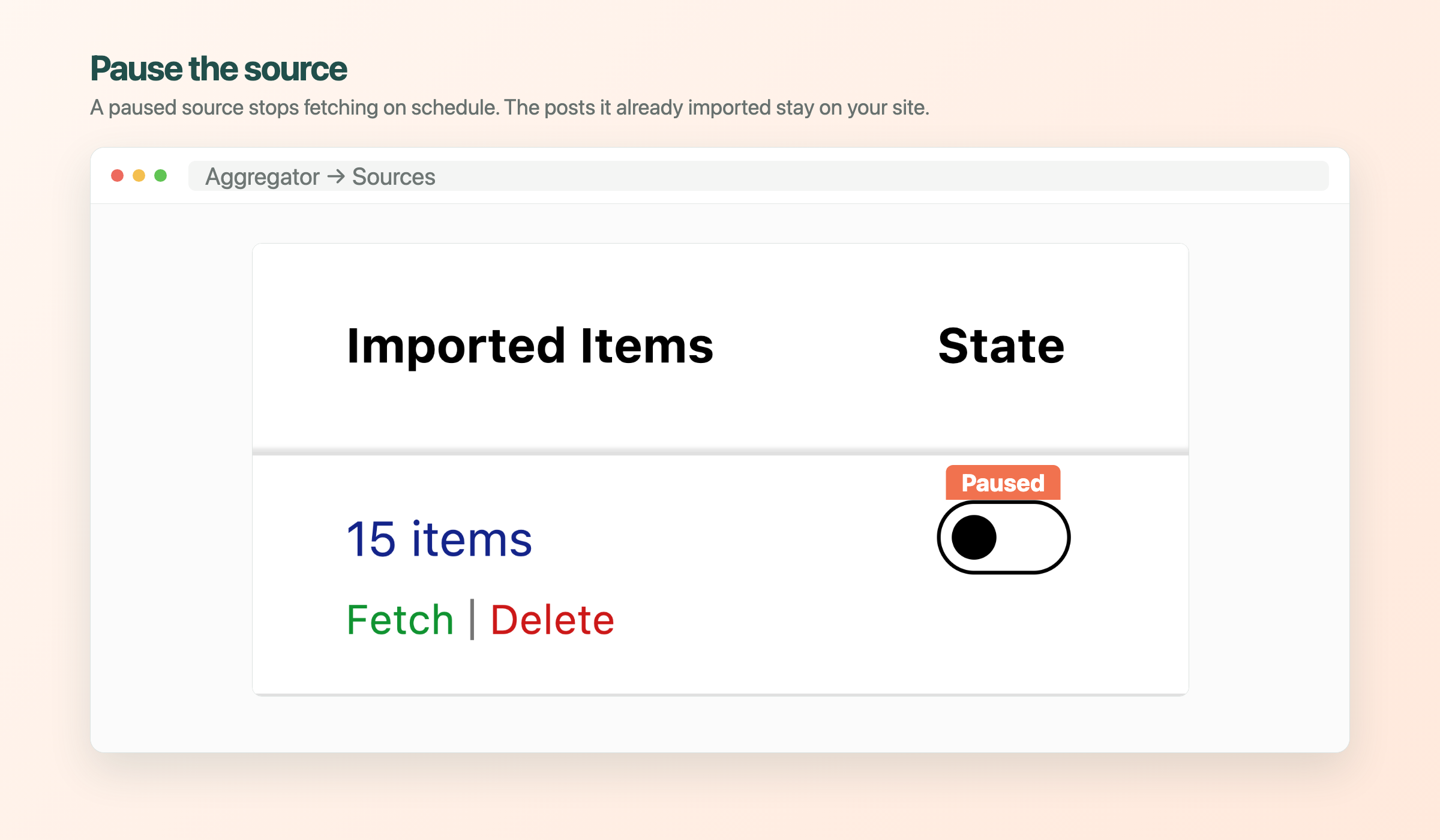
Keep it as an archive. Leave the source running until November 13 so it can import whatever Reddit still serves, then pause it with its toggle. The imported posts stay in the sidebar. Retitle the sidebar so visitors don’t expect new posts, and check the age limit under Advanced → General so it won’t delete the archive later.
Swap in a new feed. Add the replacement, such as a photography blog’s RSS feed, as its own source and check what it imports for a few days. When it fits, edit the display to select the new source and deselect r/photography, then rename the sidebar to match.
Drop the section. Remove the display’s block or shortcode from the page, then pause the source.
With its toggle switched off, the source is paused. Its Imported Items count stays the same.
After any of these, open the page and check it as a visitor would.
Don’t use Delete under Imported Items. It permanently deletes everything the source imported, and after November 13 there’s no feed to import those posts from again.
Questions about the Reddit RSS shutdown
Have Reddit RSS feeds already been discontinued?
Not yet. The shutdown is scheduled for November 13, 2026. If a Reddit feed stops working before then, check the usual causes first, such as rate limiting (a 429 error) or a refused request (a 403). Our Reddit RSS feed guide covers the URL formats and how to troubleshoot them.
Is the Reddit API shutting down too?
Not on the same day. Reddit is moving apps off its public API and onto its Developer Platform on a separate schedule, and the remaining public API access ends in March 2027.
Can a different feed URL get around the shutdown?
No. Reddit is retiring its RSS feeds as a whole and hasn’t announced an exception for any URL format, so changing the address won’t keep a feed alive after November 13.
Sort your Reddit feeds before the cutoff
For each Reddit feed, decide whether you followed it for the people or for the links. Follow communities on Reddit. Replace link and news feeds with feeds from somewhere else, and run each replacement next to its Reddit feed before November 13 so you can compare them.
For a Reddit display on your site, choose archive, swap or remove, and check the age limit before you leave an archive in place.
In the example setup, that puts r/homelab on Reddit, r/programming on Hacker News and r/spacex in a SpaceX news search, with the photo blog’s sidebar either archived or switched to a new source.
For Aggregator users
Review the feeds your site depends on
Find each Reddit source, see which displays use it, and pause it without deleting what it imported.